
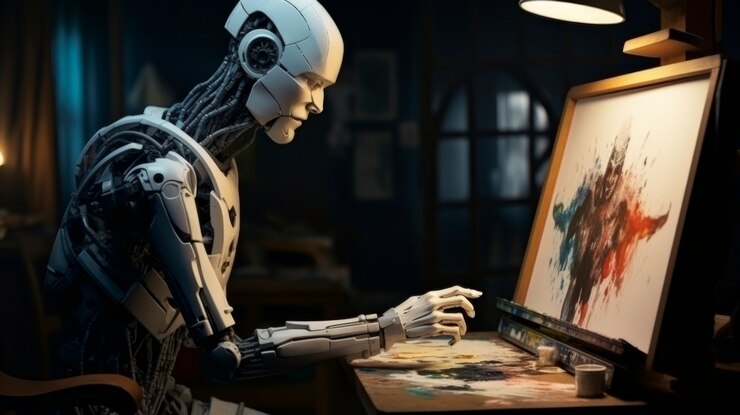
The Creative Revolution: How Artificial Intelligence is Reshaping the Contemporary Art Landscape

In the last decade, artificial intelligence (AI) has become an unexpected protagonist in the world of art. As technology advances, the tools available to creators have become increasingly sophisticated, allowing them to explore new forms of expression. From music and literature to painting and visual design, AI is not only facilitating the creation of works but also challenging the very notion of what it means to be an artist.
One of the most striking examples of this is the use of generative algorithms that can create musical compositions or visual pieces based on patterns and styles learned from human artists. These works often spark debate: can machines truly be creative, or are they simply replicating what they’ve learned? Nevertheless, what is undeniable is that the fusion of human creativity with AI’s processing power is giving rise to innovative and surprising works of art.
Artists like Refik Anadol have used AI to create immersive installations that challenge viewers’ perceptions. His work “Melting Memories,” for example, uses neural networks to transform memories into artistic visualizations, creating a bridge between technology and human experience. This kind of intersection is considered the new era of contemporary art, where the organic and the digital collide in unexpected ways.
Another fascinating aspect of artist-AI collaboration is deep learning, which allows machines to learn from large volumes of data. Tools like OpenAI’s DALL-E can generate images from textual descriptions, enabling anyone to become a creator. This has led to a surge of platforms where people can experiment with artistic creation without prior training, further democratizing access to art.
The concept of “collaborative art” has also gained ground thanks to AI. There are projects where human artists and machines work together to produce works. This process not only serves as a means to create art but also raises questions about authorship and intellectual property. Who is the true author of a piece created with an algorithm: the artist or the AI? These questions are particularly relevant in an era where creativity is constantly being redefined.
Despite controversies, it is undeniable that AI is helping artists overcome creative blocks. AI tools can offer suggestions and variations, acting as a “co-creator” that stimulates new ideas. This allows artists to experiment with concepts they might not have explored otherwise, as AI serves as a catalyst for imagination.
However, some fear that AI could replace human artists. While it is true that automation can reduce some traditional tasks, there is growing consensus that AI cannot replicate human intuition and experience. Instead, what seems to be emerging is an enriching combination: AI provides new possibilities, while human vision and emotion remain irreplaceable in artistic creation.
On the other hand, AI is also beginning to influence the way we consume and experience art. Virtual exhibitions and online galleries powered by AI technologies allow for completely new interactions with artworks. Viewers can explore immersive artistic spaces from the comfort of their homes, experiencing art in ways that were previously impossible.
Limitless Creativity: New AI-Driven Design Tools
While AI has left its mark on the art world, its impact on modern design is equally profound. With the rise of AI-based tools, designers across disciplines are rediscovering the potential of their creativity, breaking barriers, and experimenting with new techniques. Imagine creating logos in minutes or experimenting with entirely innovative color palettes and styles with just a few clicks.
AI is revolutionizing design offices and creative studios by allowing designers to focus more on conceptualization and strategy rather than solely on execution. Platforms like Canva, for example, have integrated AI features that automatically suggest designs and combinations, enabling users—from hobbyists to professionals—to create visually impactful works without being design experts.
Fashion has also embraced AI in surprising ways. Brands like Dior and Gucci are using algorithms to predict trends and experiment with designs. AI analyzes social media data and potential sales to generate looks that will appeal to consumers. This creates a symbiosis between art and commerce that can benefit both.
A notable example is AI-generated fabric patterns. Systems have been developed that analyze styles from different eras and design new patterns inspired by them, combining classic and modern aesthetics. This not only challenges designers’ creativity but also provides them with a wealth of new ideas that merge styles, techniques, and cultures.
Architecture is another field where AI is leaving a significant mark. Using advanced software that simulates light, acoustics, and other factors, architects can design buildings that are not only aesthetically pleasing but also functional and sustainable. This allows for a more holistic approach that effectively integrates the environment and users’ needs.
Additionally, AI can enhance customer experiences in graphic and advertising design by using predictive analytics to tailor campaigns, achieving a stronger emotional connection with audiences. This combination of creativity and data analysis is opening new doors for designers, allowing them to provide more personalized and effective solutions.
AI tools are democratizing design, giving people without prior training access to advanced software and allowing them to explore their creative side. This has led to a greater diversity of voices and styles in the design field, enriching the overall landscape and fostering innovation.
Of course, much remains to be learned and explored in the relationship between AI and design. As new technologies develop, it will be fascinating to observe the evolution of tools that not only facilitate but also inspire creation. The true essence of creativity, however, remains anchored in human experience, emotion, and cultural context.
Collaborations between humans and machines are just the beginning of an exciting future where creativity knows no boundaries. Imagination, powered by artificial intelligence, is transforming not only how we create but also how we think and feel about art and design. The synergy between human ingenuity and computational power promises a future where creativity is more accessible and diverse than ever.
In conclusion, artificial intelligence is at the forefront of a creative revolution that is redefining modern art and design. From production to consumption, and from education to professional practice, AI has the potential to be an invaluable tool. By embracing this new era, artists and designers can constantly push the boundaries of what is possible, offering a broad spectrum of expressions that captivate, inspire, and surprise. Limitless creativity is here—and it is powered by artificial intelligence. The future is bright and full of possibilities!